

Now Let Us Rejoice: The Story Behind the Hymn
The first time I really paid attention to the words of "Now Let Us Rejoice," I was sitting at the console waiting for the opening hymn, and it struck me that the man who wrote them had very little to rejoice about. William W. Phelps penned this hymn in a Missouri settlement that was only months away from being torn apart, and yet he wrote about peace, gathering, and a day when the Saints would no longer be strangers.
It sits at number three in our 1985 hymnbook, so most of us have sung it more times than we can count. That familiarity can hide how remarkable it is. Its story deserves a little more care from those of us on the organ bench.
W. W. Phelps and the Hymn's Missouri Beginnings
After joining the Church, Phelps was sent to Independence, Missouri, where he set up a printing office and began publishing The Evening and the Morning Star, the Church's first newspaper, in June 1832. That same year he was asked to help Emma Smith gather hymns for the Church's first hymnbook. When A Collection of Sacred Hymns finally appeared in 1835, his words were in dozens of its hymns, either as original texts or as adaptations of older ones.
"Now Let Us Rejoice" first appeared in the March 1833 issue of the Star, under the simple title "Home," opening with the line "Now let us rejoice in the day of salvation." You will sometimes read that Phelps wrote it after the Saints were driven from Jackson County, but the dates do not support that. It was in print months before the expulsion. Then, on July 20, 1833, a mob destroyed Phelps's printing office, and by the end of that year the Saints had been forced out of the county altogether.
I find that order of events more moving, not less. Phelps was not writing a brave song after the storm. He was writing a song of hope while the clouds were already gathering, and the Saints carried it with them into everything that came after. It went into Emma's 1835 hymnbook, and Latter-day Saints have sung it ever since.
The Theology of Zion in "Now Let Us Rejoice"
Read the verses slowly and you will notice how little of the hymn is about the present. It looks forward to a time when the promises made to the Saints are fulfilled, when they are gathered in peace, and when the Lord reigns on the earth. The hymnbook cross-references Moses 7:61–67, where Enoch sees the latter-day gathering of Zion and the earth finally resting, and the tenth article of faith, which speaks of the gathering of Israel and Christ reigning personally upon the earth.
That is what gives the hymn its particular joy, and that joy never depended on life being easy. It trusts that the Lord keeps His promises, even when a printing press lies broken in the street. When a congregation sings it on an ordinary Sunday, we are joining a very old act of faith: rejoicing ahead of time.
I have written before about how the story behind "Come, Thou Fount of Every Blessing" changed the way I play it, and this hymn works the same way for me. Once you know what Phelps was facing, the refrain sounds a lot more like testimony.
Playing "Now Let Us Rejoice" on the Organ
The tune we sing today is not the one the earliest Saints knew. Our setting is credited to Henry Tucker, an American songwriter born in 1826, whose tune dates from the 1860s, so early Saints sang these words to other melodies for decades before Tucker's music became attached to them. His tune, in D major in our hymnbook, has a natural lift to it, and the organist's job is mostly to stay out of its way.
A few things help. Choose a bright, clear registration rather than a heavy one; principals at 8' and 4' with a light mixture usually carry a congregation better than piling on reeds. Keep the tempo moving so the phrases feel like they are going somewhere, and give the repeated notes a slight separation so the rhythm stays crisp and the room can hear where the beat is. When you reach the refrain, let the sound open up a little rather than slowing down. The text is looking forward, and the music should too.
It also makes a lovely prelude. If you are building a set of opening music and want something hopeful to place beside more reflective pieces, my notes on planning prelude music for sacrament meeting walk through how I balance a program.
The next time "Now Let Us Rejoice" shows up on your hymn board, I hope you will think of Phelps at his printing office in Independence, publishing a hymn about home while his own was about to be taken from him. That is a song worth playing well.
If you would like a quiet, playable version for the minutes before the meeting starts, my Now Let Us Rejoice easy organ prelude sheet music keeps the melody clear and the pedal part manageable, so you can focus on bringing out the hope in this hymn.

Silent Night Free Canon - Organ Sheet Music

Away in a Manger Intermediate Piano Solo
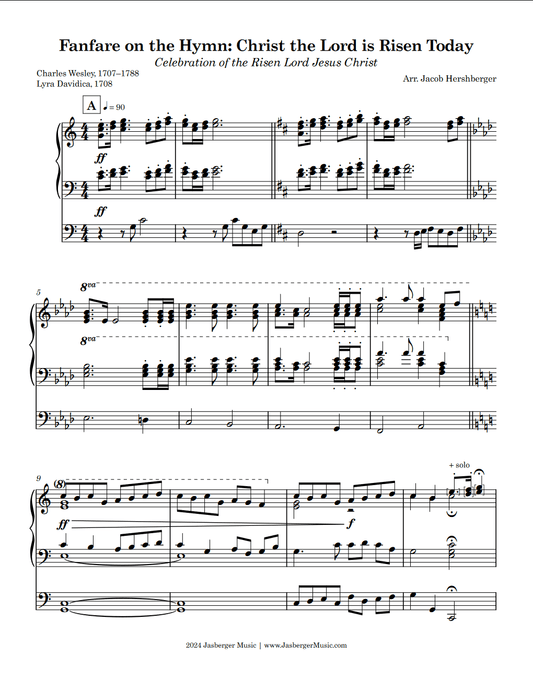
Christ the Lord is Risen Today – Easter Organ Fanfare
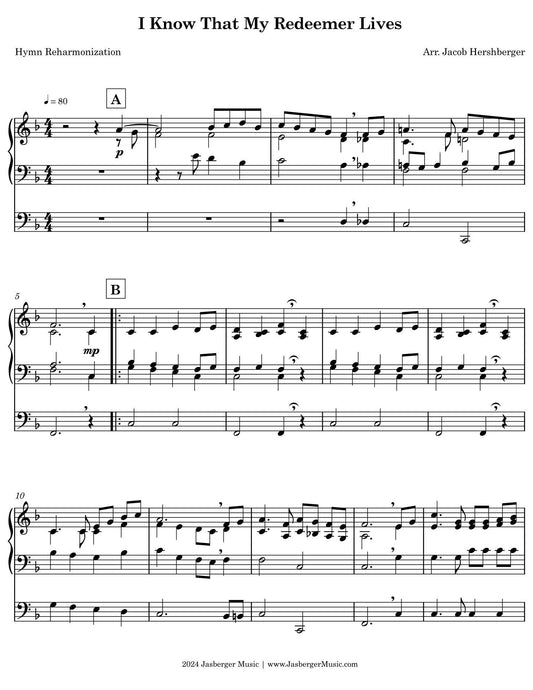

I Know That My Redeemer Lives – Organ Reharmonization
View Comments
Leave a Comment
No comments

Organ Legato for Hymns: Finger Substitution and Ties

How to Mark Your Sheet Music Before Sunday




comments